What Really Changes with ISO 10993-1:2025
In November 2025, ISO 10993-1:2025-Biological evaluation of medical devices-Part 1: Requirements and general principles for the evaluation of biological safety within a risk management process (sixth edition) was published, updating the standard by introducing greater alignment with risk management principles, as well as certain changes in terminology and in the approach to toxicological justification.
The 2025 edition introduces significant conceptual and structural changes that directly affect how manufacturers should plan, conduct, and justify biological safety.
What’s New in ISO 10993-1:2025?
Biocompatibility is no longer treated as a collection of discrete tests, but as a holistic evaluation of biological safety, fully embedded within the medical device lifecycle and fully aligned with the ISO 14971 risk management framework.
- The standard places stronger emphasis on chemical and physical characterization as the foundation for identifying biological hazards, moving away from a checklist-driven approach. Physical and chemical information contributes to the overall biological evaluation and may be used to determine, where necessary, the need for additional testing.
- The checklist mentality, historically associated with Table A.1 of ISO 10993-1:2018, is explicitly abandoned in favor of a risk and biology driven evaluation framework, based on biological effects, type of tissue contact, and exposure duration.
- Medical devices shall be categorized in accordance with their type and duration of body contact. Contact categorization has been redefined by tissue type, including intact skin, mucosal membranes, breached or compromised surfaces, internal tissues (other than circulating blood), and blood. The evaluation of biological effects is now structured into four contact-specific tables.
Concepts such as contact day and total exposure period are formally introduced, eliminating ambiguity and improving consistency especially for reusable devices or multiple exposure scenarios
A key methodological update is the requirement to consider not only intended use but also reasonably foreseeable misuse, where such scenarios may alter exposure conditions or the overall risk profile.
- The scope of biological evaluation is expanded to include, where relevant and justified, other biological effects such as immunotoxicity, neurotoxicity, and reproductive or developmental toxicity.
The standard reinforces ethical responsibility by explicitly requiring the minimization of animal testing, in line with the principles of Replacement, Reduction, and Refinement.
Within this evolving landscape, Gap Analysis becomes the key tool for managing complexity in a controlled, proportionate, and scientifically defensible manner.
Why starting with a Gap Analysis?
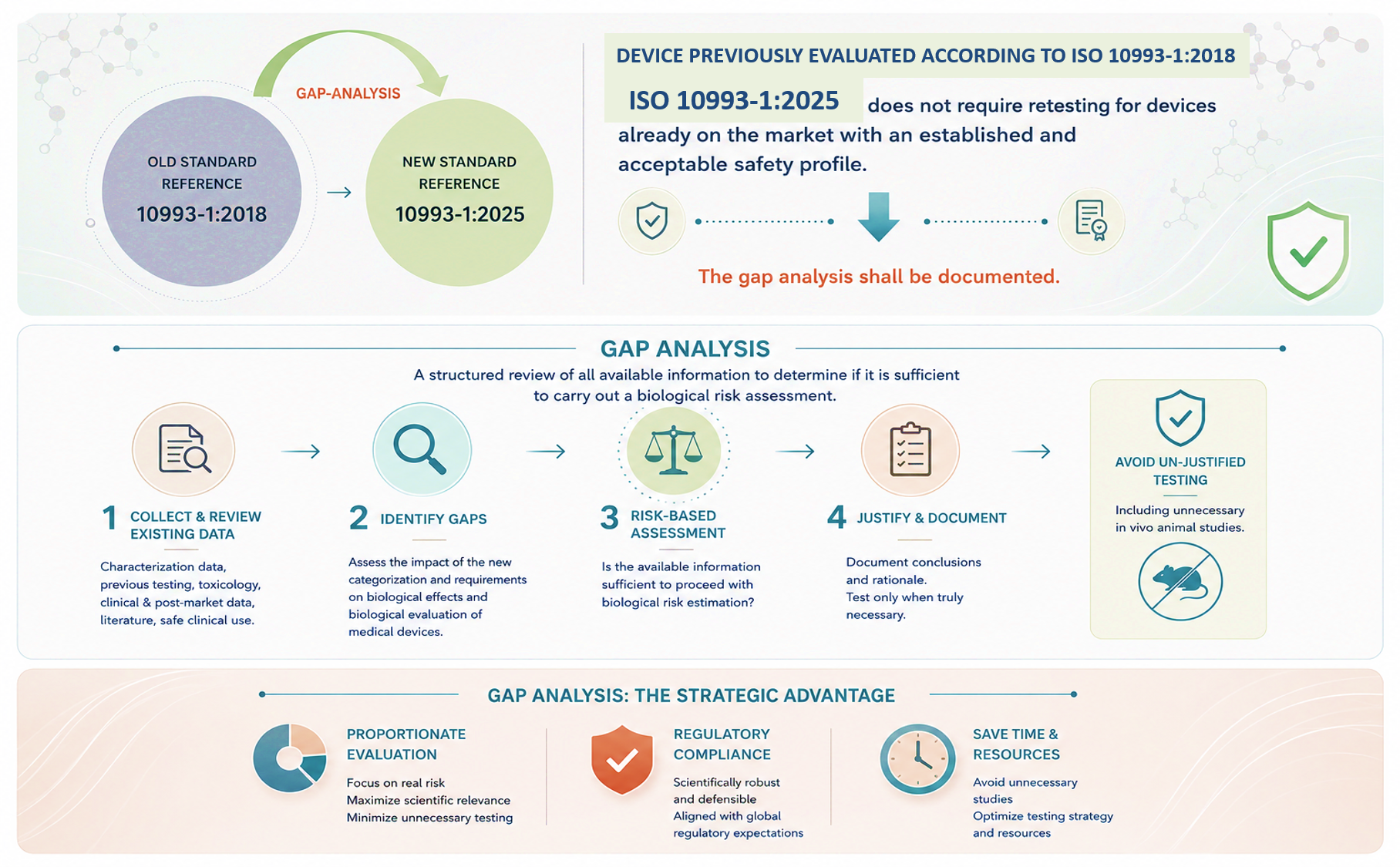
With the publication of ISO 10993-1:2025, the biological evaluation of medical devices has undergone a fundamental shift. What was historically perceived as a largely test-driven exercise is now clearly positioned as an integral part of a risk management process fully aligned with ISO 14971. The standard does not require retesting of devices already on the market that have an established and acceptable safety profile. Within this updated framework, Gap Analysis is no longer an optional or secondary activity, it is the logical, mandatory, and scientifically justified starting point of any biological evaluation strategy.
Nevertheless, it is still common for many manufacturers to follow a conventional approach, initiating new testing activities and repeating in vitro or in vivo studies before fully evaluating whether such studies are scientifically justified or necessary. This approach not only increases costs and timelines but may also result in ethically questionable animal testing with limited regulatory or scientific benefit.
ISO 10993-1:2025 delivers a clear and unambiguous message: existing data must be reviewed, analyzed, and critically assessed first. Only when this body of evidence is demonstrably insufficient should new data be generated.
Gap Analysis: an activity regulated within ISO 10993-1:2025
ISO 10993-1:2025 dedicates specific clauses to Gap Analysis (6.6.1 and 6.6.2), defining it as:
A review of the available information to determine if the information is sufficient to carry out a biological risk assessment according to this document.
In practical terms, a Gap Analysis is a structured and critical review of all available information relevant to biological safety. This may include chemical and physical characterization data, historical biocompatibility testing, toxicological assessments, clinical and post-market data, relevant scientific literature, and documented evidence of safe clinical use.
The objective is not just to identify which tests are “missing”, but to address a far more meaningful question: is the existing body of evidence sufficient to demonstrate that the medical device does not present unacceptable biological risks, considering its specific design, materials, manufacturing processes, and intended clinical use?
Only when the answer to this question is clearly negative does the generation of new data become scientifically and regulatorily justified.
Gap Analysis is therefore the mechanism that links device characterization, hazard identification, and biological effects into a coherent and defensible weight-of-evidence approach. It enables manufacturers to select, tailor, or deliberately waive testing activities in a proportionate and scientifically sound manner.
A well-executed Gap Analysis is one of the most effective tools for avoiding unjustified testing activities, including unnecessary in vivo animal studies. It demonstrates to Notified Bodies and Competent Authorities that decisions are driven by scientific reasoning, risk management, and ethical responsibility, rather than by routine or defensive testing strategies.
Devices Previously Evaluated Under Earlier Versions of the Standard
One of the most important, and often misunderstood, messages of ISO 10993-1:2025 concerns medical devices that are already on the market.
The standard explicitly states that the new edition shall not be used to automatically mandate re-testing. A well-documented history of safe clinical use, supported by relevant biological evaluation data, may be entirely sufficient. Where application of the new framework does not introduce additional applicable biological effects, no new experimental testing is required.
In this context, Gap Analysis serves to:
- assess whether new definitions or categorization rules alter the scope of biological effects that must be considered;
- evaluate whether changes in design, materials, manufacturing processes, or intended use introduce new biological risks;
- clearly and defensibly document why additional testing is not necessary.
In many cases, a robust Gap Analysis allows manufacturers to confirm the continued validity of existing biological safety conclusions, avoiding unnecessary studies while remaining fully compliant with the new standard.
Conclusions: Gap Analysis as a Strategic Enabler
ISO 10993-1:2025 no longer asks manufacturers simply which tests have been performed. Instead, it asks:
How have you demonstrated, in a structured and risk-based way, that your medical device is biologically safe?
Gap Analysis is the answer to this question.
For manufacturers, it represents a strategic tool that supports better control of costs and timelines, minimizes unnecessary testing, strengthens scientific robustness, and improves the defensibility of regulatory submissions. It also aligns fully with modern expectations regarding ethical responsibility and sustainability.
At 1MED, we can support you in conducting comprehensive Gap Analyses across all your medical device products, ensuring immediate compliance with the requirements of ISO 10993-1:2025 and effectively addressing the expectations of Notified Bodies and Competent Authorities.
Starting with Gap Analysis is not only compliant with the new standard, it is the most effective and appropriate way to move forward.
Click here to contact our experts to schedule your ISO 10993-1:2025 readiness assessment